What the SAP Business Data Cloud Shift Means for Your Renewals
Summary of the Blog
- BDC Renewal Strategy: Understand SAP BDC consolidation and licensing.
- License Negotiation: Review transition credits, Connect features, and data entitlements.
- AI-Ready Analytics: Align BDC investments with Ariba analytics and Joule requirements.
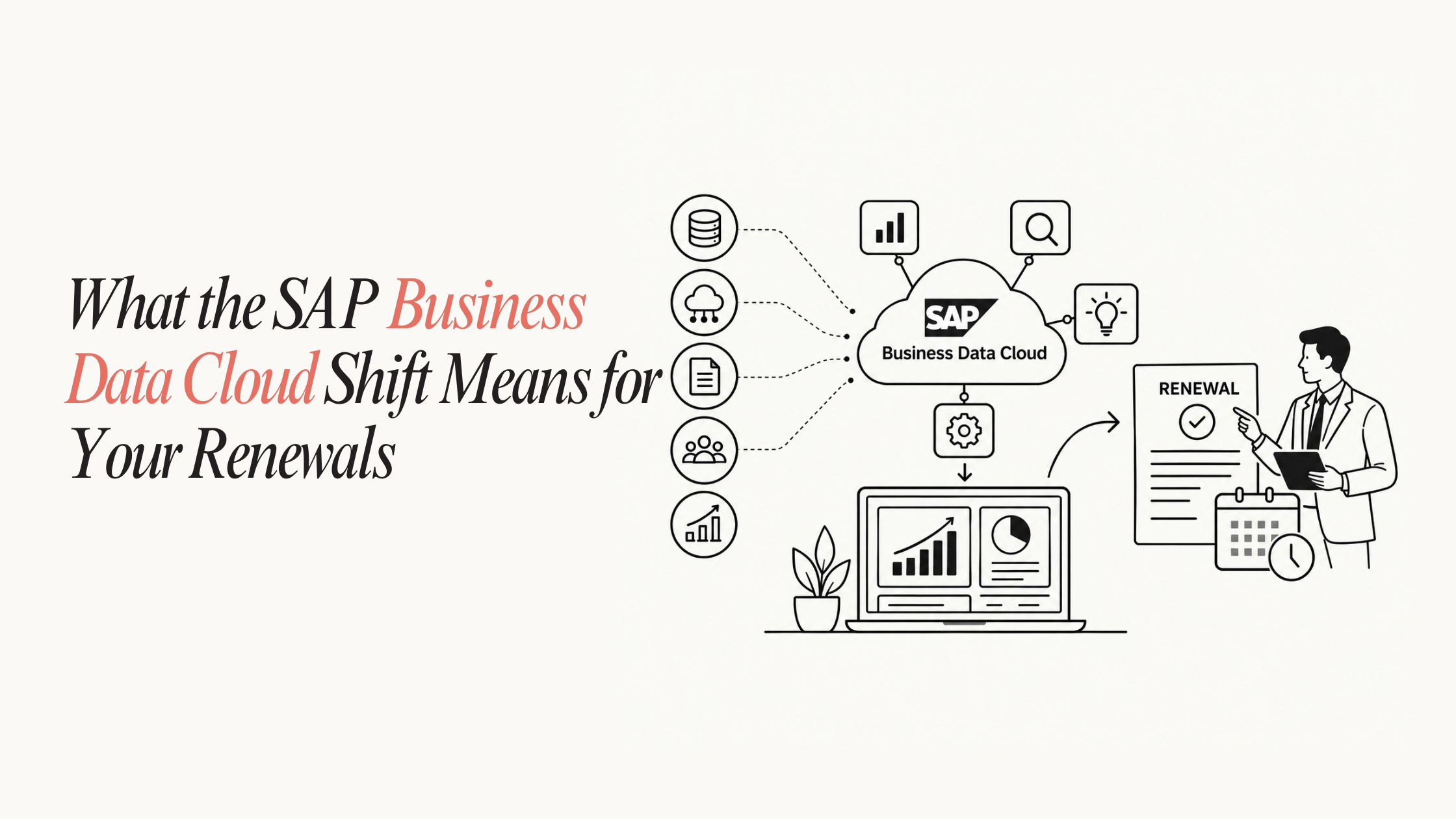
The next SAP renewal conversation is not the same conversation you had three years ago. SAP Business Data Cloud, announced in February 2025 and now moving into real-world execution through 2026, isn’t just a new product on the price list. It’s a consolidation of several products you’re already paying for – SAP Datasphere, SAP Analytics Cloud, and SAP’s curated business content library – into a single governed data platform. And the pricing model, the contract structure, and the license implications are actively being negotiated across the customer base right now.
If your renewal is in the next 12 months, this is worth understanding before you sign.
What BDC actually consolidates
SAP BDC merges what used to be three separate lines: Datasphere (data integration and semantic modeling), Analytics Cloud (analytics and planning), and pre-built industry data products. It also brings in fully managed SAP Databricks as a first-party capability. The idea is that customers stop buying and integrating these components separately and instead buy the platform.
For customers already licensing Datasphere and SAC, this generally reads as an upgrade – same capabilities, better integration, one platform to govern. For customers who haven’t invested in either yet, BDC is the on-ramp SAP wants you on. The commercial reality: SAP’s account teams are structuring renewals to move customers toward BDC subscriptions and out of piecemeal Datasphere+SAC arrangements.
Where the renewal negotiation actually matters
Three things are worth flagging in any 2026 SAP renewal that touches data and analytics. The first is transition credits. If you’re already licensing Datasphere and SAC, SAP has been extending various forms of credit to move you onto BDC without paying twice. These are negotiable and they vary. Don’t accept the first offer.
The second is BDC Connect entitlement. BDC includes zero-copy data sharing capabilities to Snowflake, Databricks, Google BigQuery, and Microsoft Fabric – with Snowflake generally available in H1 2026 and Fabric in Q3 2026. If you already run one of those platforms alongside SAP, the Connect capability is genuinely valuable – but only if it’s included in the tier you’re signing. Some tiers scope it differently. Get it in writing.
The third is data product entitlement. BDC ships with SAP’s curated data products across S/4HANA, SuccessFactors, Ariba, and industry-specific content. The scope of what’s included versus what’s paid extra is where a lot of the actual renewal delta will show up. Ask for the current data product catalog and check what’s inside your tier.
The Ariba data angle
For enterprises heavy on Ariba spend, the interesting BDC development is that Ariba data products are getting first-class treatment in the BDC data fabric. Contract, sourcing, and supplier performance data becomes queryable through the same semantic layer as your finance and supply chain data – without ETL. The value case here is real. Combined finance-and-procurement analytics that used to require a data warehousing project can be built in weeks against BDC-native Ariba data products.
If your organization runs a mature Ariba estate and you’re evaluating SAP Ariba consulting in USA options in parallel with the BDC decision, ask the consulting partner what their approach is to Ariba data product publishing in BDC. Some are working with it. Some are still relying on custom extracts. The difference will show up in your first analytics use case.
What to do before you sign
● Inventory your current Datasphere, SAC, and Databricks spend, if any. That’s your BDC transition baseline.
● List the non-SAP data platforms you’re likely to keep for the next three years (Snowflake, Fabric, BigQuery, Databricks outside SAP). Confirm BDC Connect is included for each.
● Get SAP’s current BDC data product catalog and map it against the analytics use cases on your roadmap. Anything on your list that’s not in the catalog is a custom development question.
● Ask for the Joule agent implications. Some agents depend on BDC-native data products. Renewing without BDC entitlement may lock you out of agents you’re planning to activate next year.
Where MSITEK fits
We run BDC readiness assessments for enterprises inside their renewal window. It’s a fixed-price engagement – four to six weeks – that gives you a clean picture of what your existing SAP data investments should convert to under BDC, what to negotiate for, and what’s actually going to work for your analytics roadmap. If you’re comparing the Top Global SAP Partner in USA on renewal strategy, we can walk through recent BDC transition negotiations we’ve supported and what we learned from each one.
Leave a Reply