
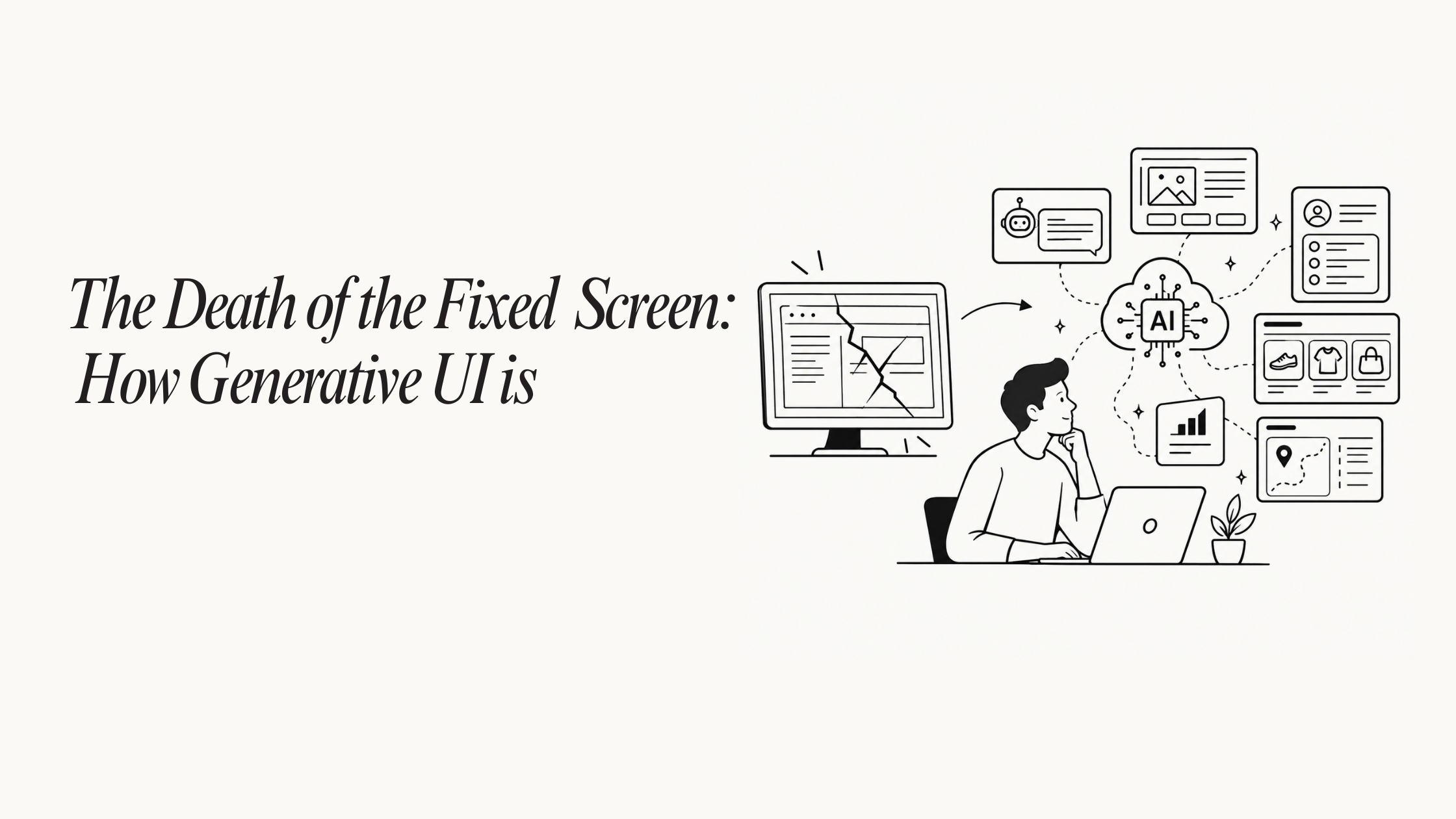
The Death of the Fixed Screen: How Generative UI is Changing the SAP User Experience
Summary of the Blog
- Generative UI Needs Strong Data & Services
- Generative UI Doesn’t Fix Core Problems
- Build an Agent-Ready Architecture
Generative UI collapses that model. The edge case gets the same treatment as the common case, because neither of them is being designed in advance. That’s the change. And it’s the reason the enterprises paying attention to this early are focused less on the UI itself and more on the plumbing – clean data, well-defined services, and BTP as the composition layer.
If you’re looking for the Top SAP BTP Partners in US to build the foundation for this, the useful question is: can they show you a service catalog they built for a client that a generative agent could compose against today? Most partners can build a screen. Fewer can build the API and data infrastructure that lets screens build themselves.
What generative UI does not fix
It does not fix bad data. If your product master has three fields for weight and none of them agree, a generative UI will surface all three of them because the AI has no way to know which one you meant. Generative UI compounds data quality problems – it doesn’t hide them the way a fixed screen used to.
It does not fix bad process design. If your approval workflow requires seven signatures and three of them are for cover, the generative UI will still route through all seven. The AI doesn’t have opinions about your process. It has opinions about how to render your process.
It does not fix change management. Users who spent a decade memorizing transaction codes and screen paths will initially be disoriented by an interface that keeps changing. The rollout requires unlearning as much as learning.
The enterprise implication
For CIOs, the strategic question is whether to invest in the last generation of Fiori extensions or
the next generation of generative UI foundations. The honest answer is both, for now. Fiori isn’t going away. It’s the baseline. But the new capital investment – the extensions being built in 2026 for use over the next five to seven years – should assume a generative composition model, not a designed-once model.
That has architectural consequences. UI logic doesn’t live in the app anymore. It lives in the semantic layer, the service catalog, and the agent orchestration. Data and services need to be described well enough that an agent can pick the right one without human help.
The enterprises evaluating the Top Global SAP Partner in USA for a five-year UX modernization program are asking about semantic modeling, service catalog design, and agent-ready API architecture – not about which Fiori theme to pick.
Where MSITEK fits
Our BTP and UX practices work together on generative UI foundation work. We start with an assessment of your existing Fiori estate – what to keep, what to retire, what to expose as a
service that an agent can compose against. Then we design the semantic and service layers that make generative UI actually work when SAP’s tooling gets there. It’s foundation work. It doesn’t make a good demo. It makes everything downstream possible.
Leave a Reply