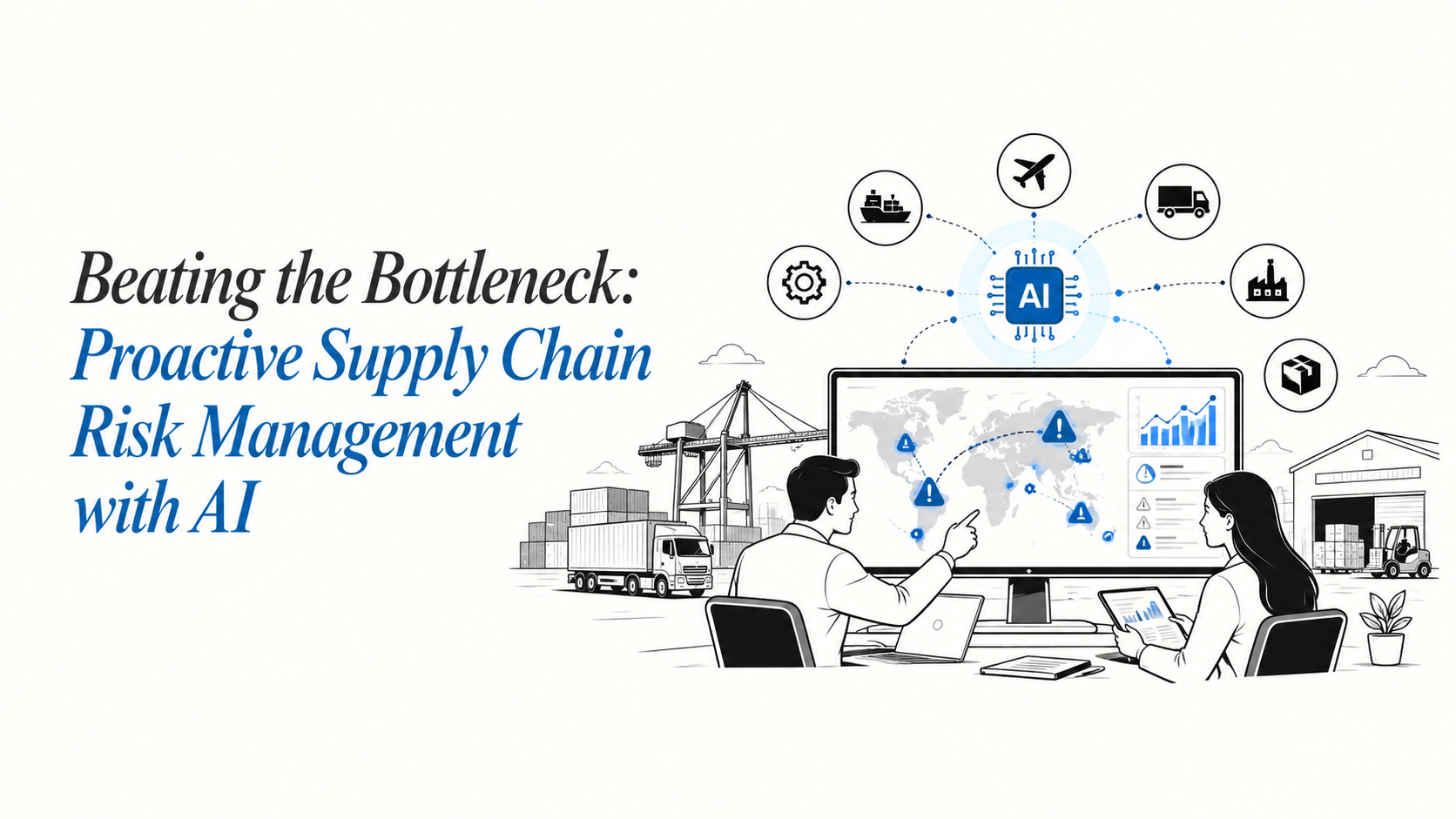
Beating the Bottleneck: Proactive Supply Chain Risk Management with AI
Summary of the Blog
- AI-Driven Risk Detection: Identify supplier delays and order risks early.
- Smarter Supply Chain Planning: Improve visibility across SAP S/4HANA, IBP, and Business One.
- 1. Proactive Decisions: Use real-time data and AI to prevent disruptions.
Supply chain disruption is not what it was in 2021. The problem has changed shape. Fewer catastrophic port shutdowns. More persistent, hard-to-see risk – a Tier 3 supplier with a solvency issue, a lane running consistently late by 36 hours, a component going end-of-life six months before your buyer has caught it. The disruption doesn’t announce itself. It compounds.
SAP’s supply chain agents in Q1 2026 are the first serious attempt at making that invisible risk visible before it hits the P&L.
What the new agents do
The Production Planning Agent, released in Q1 2026, autonomously evaluates open demand, capacity, and material availability, then releases production orders that stay inside the constraints you’ve set. It’s not just an optimizer. It monitors continuously and flags deviations – a supplier confirming late, a machine trending toward unplanned downtime – before they cascade into missed customer orders.
The Order Reliability Agent, shipping in Q2, does the customer-facing version of the same job. It watches your open sales orders against real-time supply signals – inventory positions, expected receipts, production status, transportation status – and identifies which orders are at risk of missing their committed dates. Not next week’s risk. Today’s risk. And it does the work of proposing the alternatives: expedite this component, reallocate this stock, move this order to a different plant.
For companies running SAP Integrated Business Planning, Joule now supports natural-language formula generation directly in Microsoft Excel. Planners can express complex demand shaping logic in English and get the IBP formula that implements it. That’s a meaningful productivity change for the people who spend 40% of their week wrestling with formula syntax.
Why this matters at the enterprise scale
Global enterprises don’t fail at supply chain planning because their planners aren’t smart. They fail because the data volume has outrun human attention. A large consumer goods company might run 80,000 SKUs across 12 plants and 200+ suppliers. The signals are all there – the exception reports are literally titled “exceptions” – but nobody has time to work through them all.
An agent that reads every signal, prioritizes them by revenue impact, and either resolves them or presents a decision-ready summary changes the math on how many exceptions your team can actually respond to. Enterprises evaluating the Top Global SAP Partner in USA to run a supply chain AI program in 2026 are asking a specific question: can you operationalize this without adding headcount? The answer is yes, but only if the underlying master data is clean and the IBP model is well-configured.
The mid-market angle
Not every organization runs S/4HANA and IBP. SAP Business One serves mid-market and small enterprises with a lighter footprint. B1 is getting its own AI capabilities more slowly, but the same principle applies: even a company running B1 has supplier risk, inventory carrying cost, and demand volatility to manage. For companies working with the Top SAP B1 partners in US, the practical question in 2026 is which B1 integrations and add-ons bring AI-driven supply visibility into the smaller footprint. Some of the answer is native to B1’s roadmap. Some of it is pulling supplier data into a lightweight BTP layer where AI models can act on it.
What proactive actually looks like
Proactive supply chain risk management in SAP now involves three data streams. Internal execution data – open orders, inventory, capacity, work-in-process. External signal data – supplier financial health, weather, freight index movements, port congestion. And contract data – service level agreements, penalty clauses, expiration dates that create sourcing gaps.
The Joule agents connect the first stream to the second and third. The Order Reliability Agent can now tell you not just “this order is at risk,” but “this order is at risk because Supplier X’s confirmed delivery is three days late, their credit rating dropped last week, and their alternative sourcing agreement expires in 60 days.” That’s the difference between an alert and a decision.
Where MSITEK fits
MSITEK operates as a Global SAP Partner across North America, Europe, and Asia. Our supply chain practice covers the full stack – S/4HANA, IBP, Ariba, and Business One for mid-market clients. If you’re benchmarking the top options for AI-driven supply chain transformation, we can start with a two-week assessment of your current planning process, master data quality, and the agent activation sequence that would move the needle fastest.
Leave a Reply