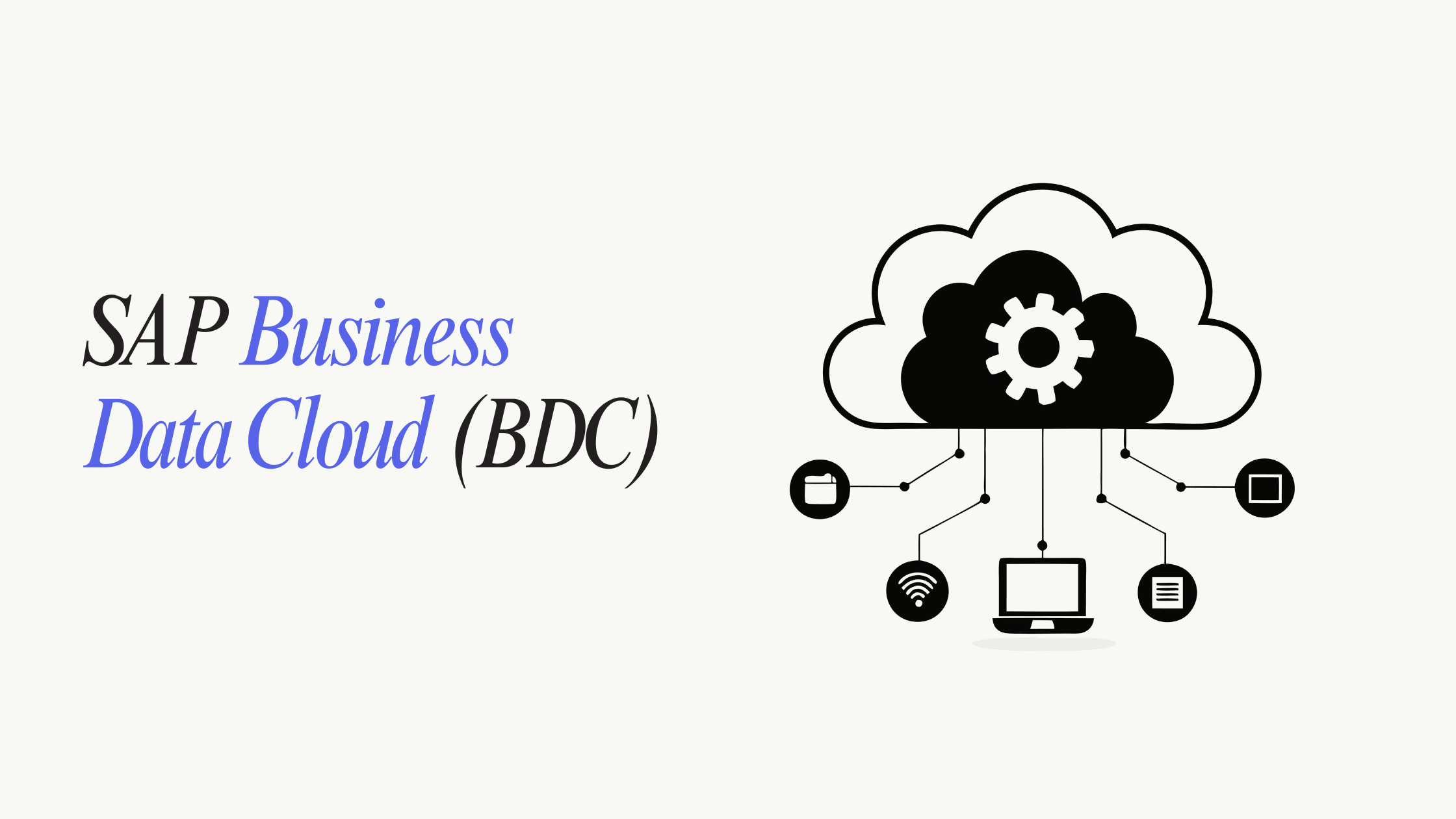
SAP Business Data Cloud (BDC)
Summary of the Blog
- Unified Data Platform: Combines SAP Datasphere, SAC, BW, and Databricks into one system.
- AI-Ready Data: Enables machine learning and intelligent applications with governed data.
- Real-Time Insights: Delivers faster decisions with integrated analytics and planning.
Everything You Need to Know
Data is the foundation of every intelligent enterprise – but for most organizations, it remains fragmented across dozens of systems, siloed by department, and stripped of business context the moment it moves between platforms. SAP recognized this as the central barrier to AI-driven decision making, and in February 2025, responded with one of the most significant product launches in its analytics history: SAP Business Data Cloud.
This blog covers everything you need to know about SAP Business Data Cloud – what it is, what it replaces, how it’s structured, who it’s for, and what it means for your SAP roadmap.
What Is SAP Business Data Cloud?
SAP Business Data Cloud (BDC) is a fully managed Software-as-a-Service (SaaS) platform that centralizes, harmonizes, and activates all of an organization’s SAP and non-SAP data in a single environment. It combines SAP’s proven data and analytics products – SAP BW, SAP Datasphere, and SAP Analytics Cloud (SAC) – with the AI and machine learning capabilities of Databricks, into one unified platform managed entirely by SAP.
In practical terms, BDC is SAP’s answer to a question every data leader has been wrestling with: ‘How do we get a single, trusted, intelligent view of our business data without spending years on complex integration projects?’
BDC is not just another analytics upgrade. It represents a fundamental rethinking of how SAP data flows from operational systems to analytical and AI-powered applications – with business context preserved every step of the way.
Why Does BDC Exist? The Problem It Solves
Before BDC, organizations with complex SAP landscapes faced a common set of data challenges:
Data Fragmentation
Sales data lived in S/4HANA. Workforce data sat in SuccessFactors. Procurement data was in Ariba. Finance had its own data warehouse. Each system spoke a different language, and combining them required expensive, time-consuming integration projects.
Loss of Business Context
When data was extracted from SAP systems and moved to third-party analytics platforms, the rich business semantics – the meaning behind the numbers – was often lost. A ‘customer’ in S/4HANA and a ‘customer’ in your data warehouse might not be the same entity.
Slow Time to Insight
Building new reports or analytics dashboards required months of work from specialized SAP data consultants. Business users had no self-service access to complex, cross-system data.
AI Readiness Gap
Generative AI and advanced ML models require clean, consistent, well-governed data as their foundation. Fragmented SAP data was simply not AI-ready.
BDC was built to eliminate all four of these barriers simultaneously, by creating a single managed platform where SAP data is unified, governed, enriched, and ready for analytics and AI from day one.
The Architecture of SAP Business Data Cloud
SAP Business Data Cloud is a modular, cloud-native architecture built on top of proven SAP technologies, extended by a strategic partnership with Databricks. Here are the core layers:
1. Data Sources Layer
BDC connects to the full SAP application suite – S/4HANA, SuccessFactors, Ariba, Concur, SAP IBP, and more – as well as non-SAP systems. Data is accessed and replicated into the BDC environment without losing business context.
2. SAP Datasphere – The Data Management Backbone
At the heart of BDC sits SAP Datasphere, which serves as the semantic and modeling layer. Datasphere provides a unified data fabric that connects, models, and governs data across hybrid and multi-cloud environments. Key capabilities include:
- Data Integration – Prebuilt connectors to SAP and non-SAP systems
- Semantic Modeling – Preserves business context and metadata through the One Domain Model
- Data Governance – Access control, data lineage, quality management
- Data Products – Reusable, governed datasets that can be shared across analytics and AI applications
3. SAP BW and BW/4HANA – For Existing Customers
SAP BW (Business Warehouse) and BW/4HANA remain an integral part of the BDC architecture, particularly for existing customers. Rather than forcing an immediate migration, BDC allows existing BW environments to continue operating within the BDC framework, with extended maintenance support through 2030. BW systems can be gradually modernized into Datasphere over time, without time pressure.
4. SAP Databricks – The AI and Big Data Engine
One of the most significant aspects of BDC is its deep integration with Databricks, now available as a fully SAP-managed version of the Databricks Serverless Lakehouse. This integration means organizations can:
- Process large-scale datasets using Apache Spark
- Train and deploy machine learning models directly on SAP data
- Run generative AI workloads without extracting data to external environments
- Combine structured SAP business data with unstructured data (IoT, logs, external feeds)
5. SAP Analytics Cloud (SAC) – The Analytics and Planning Engine
SAP Analytics Cloud provides the user-facing analytics, visualization, and planning layer within BDC. Key capabilities include interactive dashboards with real-time in-memory processing, AI-driven augmented analytics, integrated financial and operational planning, and Insight Apps (now rebranded as Intelligent Applications) – pre-built analytical applications built on top of BDC data products.
6. Intelligent Applications – Out-of-the-Box AI Insights
Intelligent Applications are predefined analytical and AI-powered applications built on SAP BDC data products, available for specific business domains. Leading partners including Deloitte, EY, KPMG, IBM, PwC, Adobe, Moody’s, and Palantir are all building Intelligent Applications on BDC, covering use cases in finance, supply chain, HR, ESG reporting, and more.
SAP Data Products: The Currency of BDC
A ‘Data Product’ is one of the most important new concepts in BDC. Rather than extracting raw data and moving it between systems, BDC introduces a structured, governed, reusable concept for packaging data with its business semantics intact.
A Data Product in BDC:
- Encapsulates data from one or more SAP applications
- Preserves business context (definitions, relationships, hierarchies)
- Is governed, versioned, and accessible via APIs
- Can be consumed by analytics tools, AI models, or custom applications
Think of Data Products as the ‘API layer’ for your SAP business data – clean, trusted, context-rich data packages that can be consumed by Intelligent Applications, Joule, Databricks ML models, or third-party tools.
BDC and SAP Joule: Better Together
SAP Business Data Cloud and SAP Joule are deeply complementary. While Joule provides the conversational AI interface for business users, BDC provides the trusted, harmonized data foundation that Joule draws from.
As Joule evolves into an agentic AI platform (capable of multi-step autonomous workflows), the quality and richness of the underlying data becomes critical. BDC ensures that when Joule answers a question about supply chain performance or financial risk, it is pulling from a single, consistent, governed source of truth – not inconsistent data from multiple isolated systems.
SAP’s vision is that BDC + Joule = Autonomous ERP: a business technology platform where AI can perceive patterns in data, reason through decisions, and take action – all grounded in trusted enterprise data.
Who Is SAP Business Data Cloud For?
SAP Business Data Cloud is designed for a wide range of organizations across the SAP ecosystem. For companies still running SAP BW on HANA (pre-BW/4HANA), BDC offers a path to modernize gradually – without a forced migration – with extended maintenance support through 2030.
SAP BW/4HANA customers can leverage BDC to elevate their existing investments into a cloud-native, AI-ready data platform. Those already using SAP Datasphere and SAP Analytics Cloud can retain their current setups and choose to “rewire” their tenants into the BDC framework to unlock its newer capabilities.
For S/4HANA customers seeking integrated analytics, BDC eliminates the need for complex external BI integrations by providing a single platform for both ERP data and analytics. Organizations with AI and machine learning ambitions will find BDC particularly compelling, as it provides direct access to SAP Databricks for model training on governed, context-rich SAP data.
Finally, enterprises managing multi-system SAP landscapes – spanning S/4HANA, SuccessFactors, Ariba, Concur, and beyond – benefit from BDC’s ability to serve as a unified data foundation across the entire suite.
What Happens to SAP Datasphere and SAP Analytics Cloud?
This is one of the most common questions customers ask. The answer is nuanced:
- SAP Datasphere and SAC will no longer be sold as standalone products going forward – they are now bundled within the BDC offering.
- Existing Datasphere and SAC customers can continue using their current solutions as-is.
- Alternatively, existing customers can ‘rewire’ their tenants to integrate them into the BDC framework, gaining access to new BDC capabilities like Data Products, Intelligent Applications, and Databricks integration.
- The rewiring process is designed to preserve existing customer investments.
MSITEK Guidance: If you are currently running SAP Datasphere or SAC, do not be alarmed. Your existing investments are protected. Talk to MSITEK about evaluating whether and when a BDC migration makes sense for your organization.
Infrastructure and Hyperscaler Support
SAP Business Data Cloud is a cloud-native SaaS offering, initially available on AWS, with subsequent expansion:
- AWS – Available from April 2025
- Google Cloud Platform – Available from July 2025
- Microsoft Azure – Available H2 2025 through Q1 2026
BDC is not available for on-premises deployments. Organizations committed to an on-premises-only strategy will need to evaluate BDC on a longer horizon as part of a broader cloud migration journey.
Key Considerations and Honest Limitations
No platform is without trade-offs. Here is an balanced view of BDC’s current limitations to be aware of:
Procurement Exclusively Through SAP
BDC – including the Databricks integration – must be purchased through SAP. Existing Databricks customers who want to leverage BDC’s SAP Data Products require a separate BDC subscription. This limits procurement flexibility for organizations with existing hyperscaler agreements.
Not an Option for On-Premises Strategies
BDC is a fully cloud-managed SaaS service. Organizations with hard on-premises requirements cannot deploy BDC in their own data centers.
Openness Is Evolving
While SAP presents BDC as an open platform, specific consumption interfaces for Data Products and Intelligent Applications are still maturing. Delta Sharing support is planned but not fully available at general availability.
BW ABAP Customization Constraints
Customers with heavily customized BW ABAP code may face constraints when migrating into the BDC framework. A free SAP BW Cloud Modernization Assessment is available to evaluate your specific situation.
The MSITEK Perspective: Why BDC Matters for Your Business
At MSITEK, we’ve guided clients through every major SAP data and analytics evolution – from BW implementations to Datasphere migrations. Our view on SAP Business Data Cloud is clear: it represents the most significant shift in SAP’s analytics architecture in over a decade, and organizations that adopt it strategically will have a significant competitive advantage in building AI-powered business processes.
The key is not rushing into BDC for its own sake, but developing a clear roadmap:
- Assess your current SAP data landscape – BW versions, Datasphere usage, analytics maturity.
- Identify your AI and analytics ambitions – what decisions do you want data to drive?
- Evaluate BDC fit – which components of BDC address your biggest pain points?
- Plan a phased adoption – start with Data Products in one domain, expand gradually.
- Connect BDC to your Joule roadmap – let the two evolve together as your AI foundation.
MSITEK can help you build a BDC readiness assessment, architecture blueprint, and adoption roadmap tailored to your unique SAP landscape and business objectives.
Get Started with MSITEK
Whether you’re evaluating BDC for the first time, planning a migration from SAP BW, or looking to connect BDC with your Joule activation, MSITEK has the expertise and the partnership with SAP to guide you from strategy to go-live.
Contact us today:
Email: info@msitekus.com
Web: www.msitekus.com
Leave a Reply